The 5-Step Stress Management Framework That Actually Works for Busy Professionals
- Chaitanya Prabhu
- Dec 27, 2025
- 6 min read

Let's be honest, if you're reading this, you're probably stressed. And not just the "I have a presentation tomorrow" kind of stressed, but the bone-deep, always-on, can't-switch-off kind that comes with being a busy professional in today's world.
You've tried meditation apps that you never use, productivity hacks that create more work, and self-care routines that feel like another item on your endless to-do list. Sound familiar?
Here's the thing: most stress management advice treats symptoms, not causes. It's like putting a bandage on a leaky pipe instead of fixing the actual leak. What you need is a systematic approach that addresses stress at its source, one that actually fits into your already packed schedule.
That's where the 5 A's Framework comes in. This isn't some feel-good theory cooked up by people who've never had to manage a team, hit quarterly targets, and deal with difficult clients all in the same week. It's a proven, practical system that works for real people with real responsibilities.
Step 1: Avoid Unnecessary Stress
The first step isn't about avoiding all stress (impossible) or becoming a hermit (impractical). It's about getting ruthless with what you allow into your life.
Think about your last overwhelming week. How much of that stress was actually necessary? If you're like most professionals, probably less than half.
The Commitment Audit
Start by listing everything you've said yes to in the past month, meetings, projects, social events, side hustles, volunteer work. Now ask yourself: "If I knew then what I know now, would I still say yes to this?"
For everything that gets a "no," you've identified a pattern. Maybe you're the go-to person for every "quick favor" in your office. Maybe you attend meetings where you add no value and learn nothing useful. Maybe you've taken on responsibilities that should belong to someone else.
The Power of Strategic No's
Learning to say no isn't about being difficult, it's about being strategic. When someone asks you to take on something new, try this response: "Let me check my current commitments and get back to you." This simple pause gives you space to evaluate whether this new thing aligns with your priorities.
Remember: every yes to one thing is a no to something else. When you say yes to staying late for a non-urgent project, you're saying no to dinner with your family or that workout you planned.

Step 2: Alter the Situation
When you can't avoid a stressor entirely, the next move is to change it. This is where most people get stuck because they assume they have no control. But you have more influence than you think.
Communication as a Stress-Buster
That weekly status meeting that drags on for two hours but only needs twenty minutes of your input? Suggest a new format. The colleague who always dumps last-minute requests on your desk? Have a conversation about planning and boundaries. The project with an unrealistic deadline? Present a clear timeline with what's actually achievable.
Here's the key: come with solutions, not just complaints. Instead of "This deadline is impossible," try "Based on the scope, I can deliver X by the original date, or Y by two weeks later. Which would work better for the business?"
Small Changes, Big Impact
Sometimes altering a situation is as simple as changing when or where you work. If open-office noise kills your concentration, negotiate some work-from-home days. If back-to-back meetings leave you frazzled, build in 10-minute buffers between them. If email notifications constantly interrupt your focus, turn them off and check messages at set times.
The goal isn't to revolutionize your entire work environment overnight. It's to make small, sustainable changes that reduce daily friction.
Step 3: Adapt Your Response
This is where the magic happens. When you can't change the external situation, you change your internal response to it.
Reframing: Your Secret Weapon
Your brain is constantly telling you stories about what things mean. A delayed project becomes "I'm terrible at my job." A difficult client becomes "This business is doomed." A busy week becomes "I can't handle my responsibilities."
But these are just stories, not facts. And you can choose different stories.
Instead of "I'm behind on everything," try "I'm prioritizing the most important things." Instead of "This client is impossible," try "This is good practice for handling challenging situations." Instead of "I'm so overwhelmed," try "I'm in a busy season that will pass."
This isn't toxic positivity, it's strategic thinking. You're choosing interpretations that help you stay effective instead of ones that drain your energy.
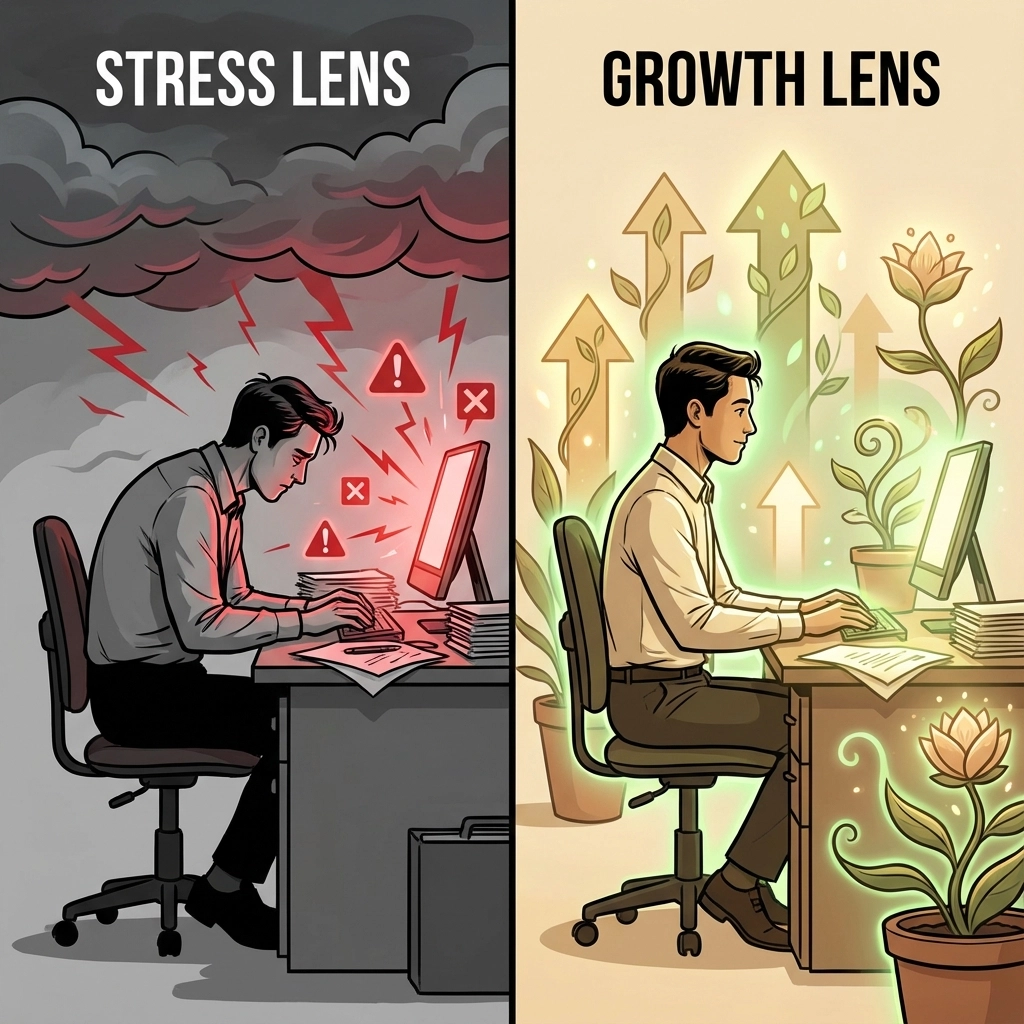
The Growth Perspective
Every stressful situation is also a learning opportunity. That presentation that went sideways? You learned what doesn't work. That project that pushed you to your limits? You discovered you're more capable than you thought. That difficult conversation you've been avoiding? It's a chance to practice a crucial professional skill.
When you start seeing challenges as curriculum instead of punishment, stress becomes more manageable.
Step 4: Accept What You Can't Change
This might be the hardest step for high-achievers. You're used to solving problems, not accepting them. But some things genuinely are outside your control, and fighting them only wastes energy you need for the things you can influence.
The Control Inventory
Make two lists: things in your control and things outside your control. Be brutally honest.
In your control: your effort, your response, your priorities, your boundaries, your skill development, your communication.
Outside your control: company restructuring, economic conditions, other people's decisions, natural disasters, your boss's mood, client preferences, industry changes.
Here's the liberating truth: you're only responsible for your list. Everything else? Not your job.
Productive Acceptance
Accepting doesn't mean giving up. It means redirecting your energy toward what you can actually influence. Can't control the budget cuts? Focus on maximizing the resources you have. Can't control your difficult coworker? Focus on your own professionalism and communication.
This shift in focus isn't just emotionally healthier, it's more effective. You'll accomplish more by putting 100% of your energy into things you can change than by splitting it between those things and others you can't.
Step 5: Attend to Your Wellbeing
This isn't the fluffy "treat yourself" advice you might expect. This is about building the physical and mental resilience that makes everything else possible.
The Foundation Four
Your ability to handle stress depends on four basic factors: sleep, movement, nutrition, and recovery time. Skimp on these, and even small stressors feel overwhelming. Take care of them, and you can handle challenges that would have floored you before.
Sleep: Aim for 7-8 hours, with consistent bedtimes. Yes, even on busy weeks. Sleep-deprived you makes terrible decisions and turns molehills into mountains.
Movement: This doesn't mean becoming a gym rat. A 10-minute walk, some desk stretches, or taking the stairs counts. Regular movement literally changes your brain's chemistry in ways that make stress more manageable.
Nutrition: You don't need a perfect diet, but you need consistent fuel. Skipping meals and surviving on caffeine creates physical stress that compounds everything else.
Recovery: Build brief recovery moments into your day. Two minutes of deep breathing between meetings. A quick chat with a colleague who makes you laugh. Looking out the window and focusing on something far away.
Quick Reset Techniques
When stress hits in the moment, you need tools that work fast. Try the 5-4-3-2-1 technique: name 5 things you can see, 4 you can touch, 3 you can hear, 2 you can smell, and 1 you can taste. This interrupts the stress spiral and brings you back to the present moment.
Or use the 4-7-8 breathing technique: breathe in for 4 counts, hold for 7, exhale for 8. Three rounds of this activates your body's relaxation response.

Making It Work in Real Life
The 5 A's Framework isn't about perfection: it's about progress. Start with one area where you have the most stress and apply one technique consistently for a week. Once that becomes automatic, add another.
Maybe this week you focus on avoiding one unnecessary stressor. Next week, you practice reframing one challenging situation. The week after, you implement one small change to alter a recurring problem.
Remember, the goal isn't to eliminate stress entirely. Some stress is motivating, energizing, even necessary for growth. The goal is to manage stress instead of letting it manage you.
You're not broken for feeling overwhelmed. You're human, dealing with genuinely challenging circumstances. But you're also capable of learning tools that make those circumstances more manageable. The 5 A's Framework gives you a systematic way to do exactly that.
Your stress doesn't have to run your life. With the right approach, you can run it instead.
Ready to take control of your stress and unlock your full potential? Explore our programs designed specifically for busy professionals who want practical solutions that actually work.
Comments